
Why 22K is the standard for bangles
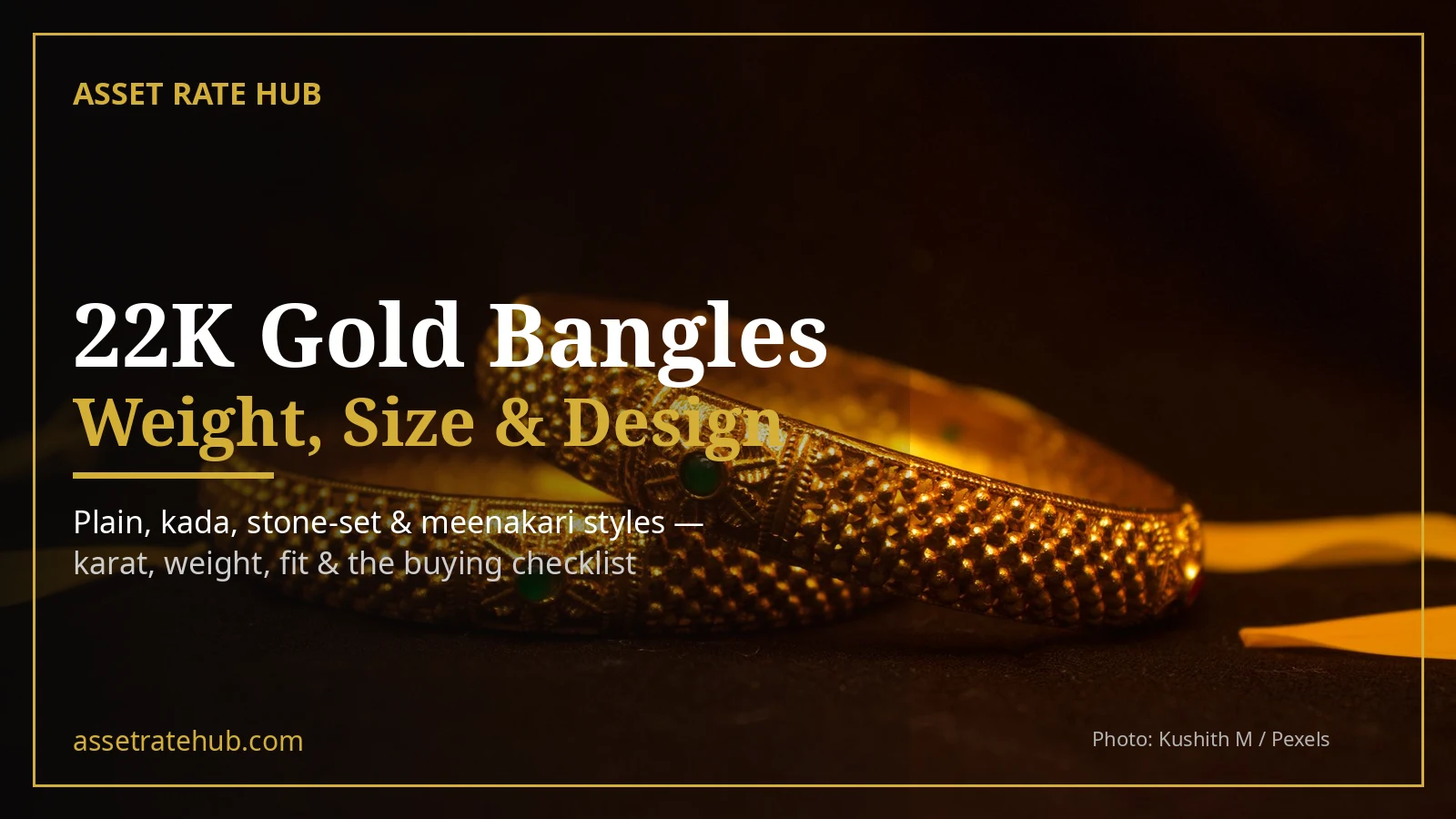
A bangle lives a harder life than a necklace or a ring: it slides on and off, knocks against tables, and takes the weight of every other bangle stacked beside it. That is why karat matters more for bangles than for most jewellery. Pure 24K gold is too soft for a bangle — it bends, dents, and loses its round shape quickly. 22K gold, at 91.6% pure, is alloyed just enough to hold its shape while keeping almost all of its gold value, which is why jewellers in Pakistan make most gold bangles in 22K. Our gold karat purity chart explains what each karat stamp means at resale: a 22K bangle is stamped 916, and it resells on its gold content at that purity, not at the full 24K rate.
Lighter everyday bangles are sometimes made in 21K, which lowers the upfront price but pays back at 87.5% purity. Whatever karat you choose, never accept a bangle without its hallmark stamp — the stamp is the only proof of what you are paying for.
The styles you will actually choose between
Plain solid bangles. A smooth, unadorned band of gold, sometimes with a light engraved or milled pattern around the edge. These are the strongest choice for value: almost everything you pay for is gold, so they resell cleanly, and they go with every outfit. If you will buy only one pair, start here.
Kada bangles. A kada is a single, thicker, rigid bangle, usually worn alone or in a pair, and often wider and heavier than a plain bangle. Kadas suit formal and bridal looks, and because they are worn one or two at a time rather than stacked, their weight is easier to judge. A wide kada in 22K is a statement piece — and a serious amount of gold, so check its weight before you fall in love with it.
Stacked bangle sets (choodiyan). The classic Pakistani look: several thinner bangles worn together on each wrist, often mixing plain gold with patterned, twisted, or coloured-enamel pieces. Sets are usually bought by the pair or by the dozen, and the total weight is the sum of every bangle in the stack — which is why a "light" set can quietly add up. Ask for the weight of the whole set, not just one bangle.
Stone-studded bangles. Bangles set with coloured stones, zircons, or small diamonds, often in kundan or prong settings. They give a festive, bridal presence, but the same rule applies as with any stone-set jewellery: at resale you are usually paid for the gold weight, not for the stones, so buy them for how they look, not as an investment.
Meenakari and enamel bangles. Enamel work in red, green, or pink laid into the gold, often paired with a matching bridal set. Meenakari bangles are popular for mehndi nights because the colour matches the outfit in a way plain gold cannot. Check the enamel before buying: it should sit flush and even, with no chips or gaps at the edges, and keep enamel bangles away from water and hard knocks.
Twist, cable, and filigree bangles. Lighter-looking designs made by twisting or weaving thin gold wire, or by cutting openwork patterns into the band. They look larger than their weight, which is the attraction — and the thing to check: a hollow or openwork bangle dents more easily than a solid one, so ask whether it is solid or hollow before you buy.
Weight: what actually drives it
There is no fixed weight for a gold bangle, because weight follows three things: width, thickness, and whether the bangle is solid or hollow. A wide, thick, solid kada weighs far more than a thin, hollow bangle of the same wrist size, even though both are "one bangle". That is why comparing bangles by looks alone misleads you — two bangles that look nearly identical can differ greatly in weight, and therefore in price.
Jewellers in Pakistan weigh bangles in tolas and grams — one tola is 11.66 grams, as our tola conversion guide explains — so ask for the weight of the pair or set in both units and write it down. As an illustrative example only, a pair weighing one tola in 22K contains one tola of 22K gold; multiply that weight by the day's live 22K rate and you have the gold value before making charges. Check the live 22K gold rate per tola on the morning you shop, so you can do that multiplication yourself.
Size: how to get a bangle that fits
Bangles are not like rings: they have to pass over your knuckles and then sit comfortably on the wrist, so a bangle that fits your wrist can still be too small to put on. The right size slides over the hand with a little resistance and then rests on the wrist without squeezing — snug enough not to slide off on its own, loose enough to move freely and not pinch.
The simplest way to check is to try the bangle on in the shop, over the hand you will actually wear it on, with your hand relaxed and slightly cupped the way you would push a bangle on at home. If it catches on the knuckles, go a size up; if it slides on with no resistance at all, go a size down. For a set, try on the whole stack, not just one bangle — a stack that fits one bangle at a time can still bind when worn together.
How the price is calculated
The price of a 22K gold bangle is calculated, not set. The formula is the same one every jeweller uses:
Total = (gold weight × live rate for that karat) + making charges (+ stone value, if any)
The gold part is the only part you can check yourself on the day. Ask for the gold weight in tolas and grams in writing, and check the live gold rate in Pakistan for 22K on the morning you shop. Making charges are the jeweller's labour margin, and they vary with how intricate the design is — a plain solid bangle carries far lower making charges than a filigree or stone-set one. Making charges are also lost completely at resale: the dealer pays for gold content only. Our guide to gold making charges in Pakistan explains how to compare them.
When a quote seems high, subtract the gold value from the quoted total; what is left is the making charge, and that number is where your negotiation lives. As an illustrative example only, a quote that bundles gold, stones, and labour into one number tells you nothing: ask the seller to split it into those three lines, and compare that split across two or three shops before you decide.
Bangle buying checklist
- Decide the occasion and the weight you can wear comfortably before you enter the shop.
- Check the hallmark on each bangle — 916 for 22K — and make sure the karat is written on the receipt.
- Get the weight in tolas and grams, in writing, for the pair or the whole set, not just one bangle.
- Try the bangle on over your knuckles, and try the whole stack together if you are buying a set.
- Ask whether the bangle is solid or hollow, and whether the quoted weight includes stones or enamel.
- Get making charges quoted separately, in writing, and compare them across two or three shops.
- For stone-set or enamel bangles, ask what is gold and what is stone, and understand that resale pays for the gold weight.
- Take an itemised receipt: weight, karat, the day's rate applied, making charges, and any stone charges as separate lines.
Care that keeps bangles round and bright
Bangles take more knocks than any other jewellery, so care is mostly about avoiding damage. Take them off before heavy housework, exercise, or anything that bangs your wrists against hard surfaces — a dented hollow bangle is difficult to repair cleanly. Put them on after perfume and lotion, wipe them with a soft, dry cloth after wearing, and store them flat in a lined box or a soft pouch so they do not scratch each other or roll off a shelf. Keep stone-set and enamel bangles away from water and store them separately from plain bangles. If a bangle goes out of round or a stone loosens, take it to a jeweller rather than bending it back yourself — gold work-hardens, and a home repair can crack the band.
Today's 24K Gold Rate in Pakistan: Rs. 430,137 / tola
Apply these concepts directly with our real-time precious metals calculation tools.
Frequently Asked Questions
Is 22K or 24K better for gold bangles?
22K is the better choice for bangles. At 91.6% pure it is hard enough to hold its shape through daily wear, while 24K gold is too soft for a bangle and bends and dents easily. 22K also keeps most of its gold value at resale, so it is the standard jewellers in Pakistan make bangles in.
How do I find my correct bangle size?
Try the bangle on over your knuckles on the hand you will wear it on: it should slide on with a little resistance and sit on the wrist without squeezing. Bangle sizes are usually given as the inner diameter in inches, with 2.4, 2.6, and 2.8 common sizes. For a gift, measure straight across the inside of a bangle the person already wears — that diameter is the size to ask for.
How is the price of a 22K gold bangle calculated?
By weight times the day's live 22K rate, plus making charges, plus any stone value. Check the live 22K rate on the morning you shop, multiply it by the bangle's weight in tolas, and subtract that gold value from any quote — the remainder is the making charge, which is the part you can negotiate.
Are stone-studded gold bangles a good investment?
Buy them for how they look, not as an investment. At resale you are usually paid for the gold weight only, not for the stones, and making charges are lost. A plain solid 22K bangle holds its value best, because almost everything you pay for is gold.
Why do my gold bangles lose their shape?
Usually because they are too soft for how they are worn: 24K bangles bend easily, and hollow or thin bangles dent under knocks that a solid 22K bangle would shrug off. Take bangles off before heavy work, store them flat so they do not roll and knock, and have a bent bangle repaired by a jeweller rather than bending it back yourself.